
Medieval Chant, its Theories and the Ancient Classical Musical World: Points of Intersection?
Venezia - Biblioteca “Gianni Milner”, Fondazione Ugo e Olga Levi
- Canale YouTube Fondazione Levi
Fondazione Ugo e Olga Levi
Dipartimento dei Beni Culturali – Università degli Studi di Padova
Lyra S.r.l Impresa Sociale
International Conference
Venice, Fondazione Ugo e Olga Levi
Diretta Canale YouTube
November 14-15, 2025
When Abbot Cirillo Martini sailed through the Venetian Levant at the end of the 18th century in search of Hellenic knowledge and art on behalf of the Nani family, he conducted various musicological investigations into Byzantine chant, seeking new insights into the mousike of the Ancients. For centuries, Byzantium has been regarded as a privileged gateway for exploring a body of knowledge considered foundational even to Latin Western civilizations—and in Venice, the legacy of Cardinal Bessarion stands as a shining example of this.
Greek musical theory was always one of the four key branches of knowledge for the Byzantine educated classes, who became its custodians and advocates, even when Constantinople fell to the armies of Mehmed II. The specific nature of Byzantine sacred chant (psaltike techne) developed alongside the not-inert preservation of classical musical theory. These two musical systems are often treated separately by the scholarly community, each with its own distinctive features and requiring specific areas of expertise. Nevertheless, complex intersections did arise, often rooted in the shared Greek linguistic heritage.
This congress, organized by the ‘Psaltike’ study group under the auspices of the Ugo and Olga Levi Foundation, seeks to explore new aspects of the interaction between psaltike and mousike through multidisciplinary approaches. Topics will include the modal system and its structure across Greek-Latin antiquity, the Byzantine Middle Ages, and Armenian culture, drawing on treatises and musical manuscripts as primary sources. Lexical analyses will also be presented, such as those concerning musical terminology in Byzantine encyclopedism, the names of neumes, and descriptions of the human voice. The concept of ethos will be studied through Byzantine epigrams on the modes, and will also serve as a basis for examining aesthetics in both ancient and medieval Greek music.
Interventi di:
Maria Alexandrou
Ancient Greek Harmonies, Byzantine Modes and the Old Sticherarion
Charles Atkinson
On Boethius, Ptolemy, the Expositor of the Alia musica, and the Modes
Sandra Martani
Ethos, Pathos, and Logos in the Modal Epigrams of the Codex Berat 23
Silvia Tessari
Musical Terms and Concepts in the Suda Lexicon (10th c.)
Christian Troelsgård
Ancient Inspirations in the Terminology and Classification of Byzantine Neumes
Haig Utidjian
Observations on an Armenian Source on the Origins of the Church Modes
Nina-Maria Wanek
Musical Ethos and Sacred Expression: The Aesthetic Aims of Music in Antiquity and Byzantium
Gerda Wolfram
The Human Voice in Ancient Classical Greek Texts and in Byzantine Musical Treatises
Ingresso libero
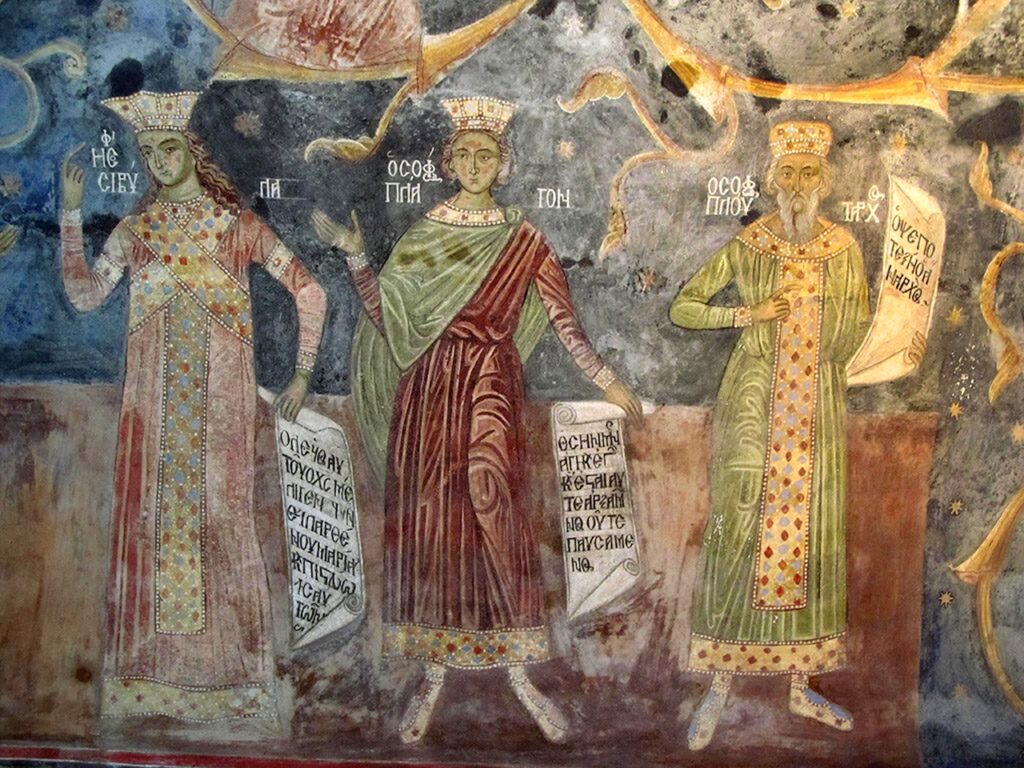
immagine, affresco del Monastero Di Bachkovo, Bulgaria (XVII secolo)